Instructors
Guided by long-term practice and quiet dedication.

Andrew Lebar
Godan Aikido · Joden Ki
Started chasing martial arts after seeing Bruce Lee in 1967 — and found what he was looking for in a 1988 KU class taught by Tsubaki Sensei.
Andrew's path to Aikido started with Bruce Lee in 1967. Fascinated by martial arts as a kid and in plenty of schoolyard fights through the early '70s, he noticed something that bothered him: win or lose, every fight left him feeling sick to his stomach. Something was missing.
He found it almost by accident. A 1988 KU course catalog listed ten martial arts — nine he recognized, one he didn't. Curiosity won out. The "little old Japanese man" teaching that class turned out to be Tsubaki Sensei, and Andrew was hooked after a single session. His college grades suffered; his practice didn't.
In the decades since, he has trained with Kashiwaya Sensei, Suzuki Sensei, Curtis Sensei, and Shaner Sensei, and traveled from the East Coast to Hawaii to Japan, where he studied with Koichi Tohei Sensei himself. He was part of the original group that founded the Kansas Ki Society, where he now serves as Chief Instructor.
On the mat, Andrew's focus is ki — following where uke's energy is going, staying connected to his own, and feeling the relationship between the two. He carries forward the meticulous attention to detail he learned from Tsubaki Sensei.
Suzuki Sensei told me a long time ago that you stand on the shoulders of your teachers. I try to apply my training all day, to whatever I'm doing — because Aikido and Ki development aren't only about martial arts. They're about how you approach every human being, with sincerity, conviction, and honesty.
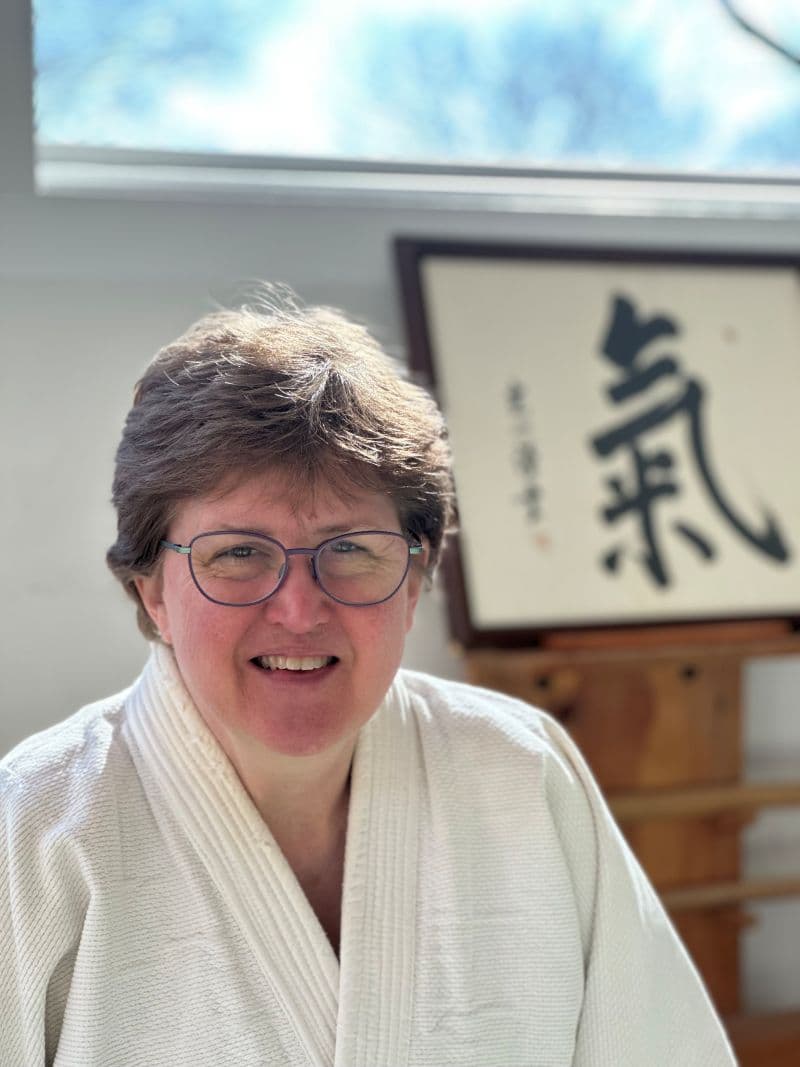
Pam James
Yondan Aikido · Joden Ki
Started Ki-Aikido in 1999 looking for self-defense and stayed for the connection — and the unexpected discovery of abilities she didn't know she had.
Pam started Ki-Aikido in 1999 after spotting a flier for an introductory martial arts class. Newly living alone, she thought self-defense would be a useful thing to learn — and when she looked the art up online, the cooperative nature of Aikido caught her attention. You can't learn to defend yourself unless someone agrees to attack.
What kept her on the mat was discovering abilities she didn't know she had. Ki-Aikido is subtle and takes a long time to master, and Pam appreciated the challenge — but the practice quickly became more than self-defense. Through seminars, she has trained with practitioners from across the country and around the world, and traveled to Japan to train at the International Headquarters. She credits Tsubaki Sensei, the founder of Kansas Ki Society, with recognizing her ability as an instructor and pushing her into teaching.
In her classes, she focuses on connection — between partners, and between students and the abilities they don't yet know they have. Her hope is that her students eventually surpass her, and she prides herself on demonstrating and explaining technique with clarity.
A high school Spanish teacher by trade, Pam fills her time off the mat with longboarding, e-biking, disc golf, pinball, reading, and collecting vinyl records. She has also gone free-swimming with sharks — no cage — in the Bahamas. Ask her about it, but make sure you have time on your hands.

Bob Lavendusky
Yondan Aikido · Joden Ki
Has trained in Shin Shin Toitsu Aikido since 1996.
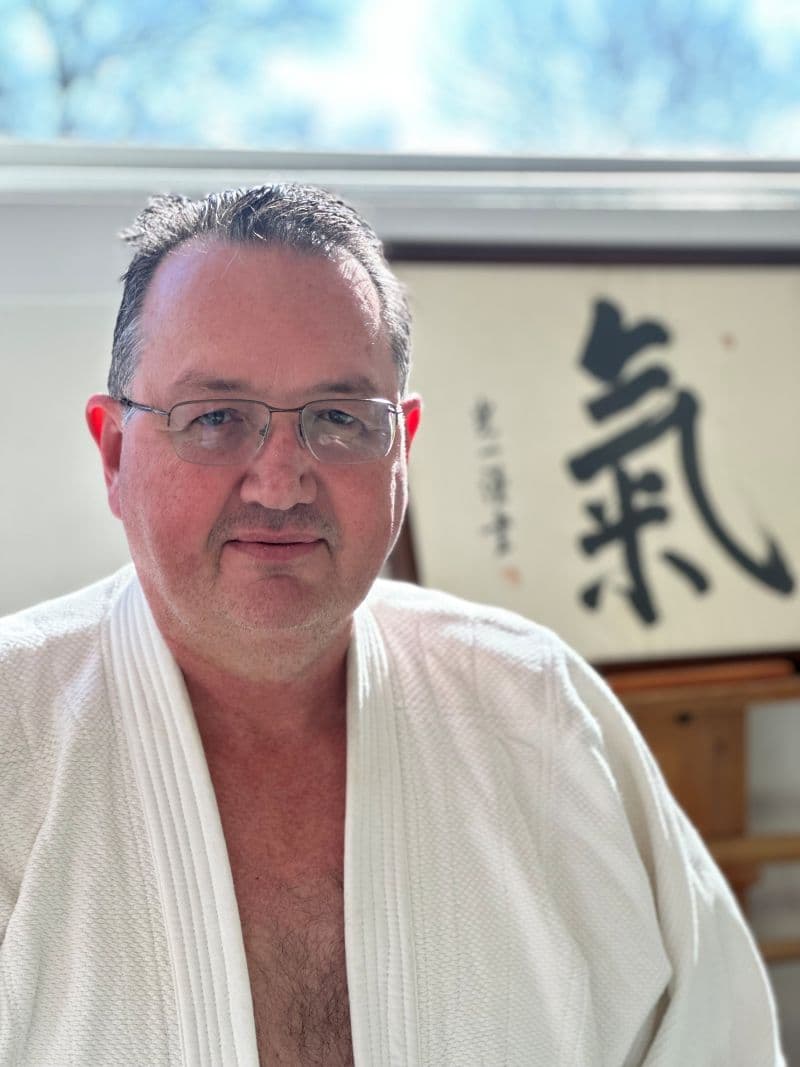
Peter Brull
Nidan Aikido · Shoden Ki
An engineer drawn to Aikido for the body mechanics — not the punching and kicking. Has been on the mat at Kansas Ki Society since 1998.
Peter grew up small for his age in western Kansas, where martial arts access in the 1980s largely meant The Karate Kid and Kung Fu: The Movie. An intellectual kid looking for a way to even the odds, he was drawn to the idea of martial arts long before he found the practice itself.
The introduction came through a friend who had trained under Tsubaki Sensei. When Peter moved back to Lawrence in 1998, that friend pointed him toward the dojo. As an engineer, he was intrigued by the body mechanics more than by punching and kicking, and he was looking for a structured exercise regimen. He joined the four-session beginner class that October and was hooked from the start.
What kept him coming back was ki. The concepts ran deeper than physical technique, and the unified mind-and-body philosophy reshaped how he handled difficult conversations at work, moments when his temper might otherwise get the better of him, and — on several occasions — situations where awareness kept him out of real harm. After a long break in the middle years, he found his way back to the mat and to the understanding that the training never really ends.
A construction inspector by trade, Peter draws on Aikido's awareness in his day job — spotting hazards, staying fluid when situations change. Off the mat, he's a voracious reader, plays roleplaying games with friends, dabbles in game design, and is working on a fantasy novel.
More than one person subjected to a pin has laughed with sheer wonder at the process. We build our own amusement park rides across the mats. The Kankou Kan truly becomes its namesake — a Hall of Daring, and a continuous cycle of exploration and discovery.